Applications of MIG/MAG Welding Machines in automotive assembly
 Sep. 09, 2026
Automotive manufacturing requires welding processes that can deliver high productivity, repeatable joint quality, and compatibility with a wide range of sheet metals and structural components. Among the many welding technologies used in vehicle production, MIG/MAG welding machines remain widely applied in automotive assembly because of their fast welding speed, continuous wire feeding, ease of automation, and ability to weld carbon steel, stainless steel, aluminum, and other automotive materials.
From body structures and chassis components to exhaust systems and automotive subassemblies, MIG/MAG welding provides manufacturers with a flexible solution for both manual production and robotic welding lines.
What Is MIG/MAG Welding in Automotive Manufacturing?
MIG and MAG are both gas metal arc welding processes in which a continuously fed wire electrode melts to form the weld joint.
The main difference is the shielding gas used:
MIG welding, or Metal Inert Gas welding, normally uses inert shielding gases such as argon or argon-helium mixtures. It is commonly used for aluminum and other non-ferrous materials.
MAG welding, or Metal Active Gas welding, uses active shielding gases such as carbon dioxide or argon-CO₂ mixtures. It is widely used for carbon steel and low-alloy steel automotive parts.
Because the welding wire is fed continuously, MIG/MAG welding machines can maintain relatively high deposition rates and welding speeds. This makes the process particularly suitable for repetitive automotive production.
Major Applications of MIG/MAG Welding Machines in Automotive Assembly
1. Automotive Body Structure Welding
Vehicle body manufacturing involves joining numerous stamped and formed metal components into a rigid structure.
Although resistance spot welding is extensively used for thin automotive body panels, MIG/MAG welding is often applied where continuous welds, stronger joints, or more complex geometries are required.
Typical applications include:
Body reinforcement structures
Floor assemblies
Cross members
Door frames
Roof supports
Structural brackets
Body subframes
Reinforcement plates
MAG welding is especially suitable for automotive structural steel components because it provides good penetration and high welding productivity.
For manufacturers producing commercial vehicles, specialty vehicles, or low-volume vehicle bodies, MIG/MAG welding can also provide greater flexibility than highly specialized spot-welding equipment.
2. Chassis and Frame Welding
The chassis is one of the most structurally demanding areas of a vehicle. Components must withstand vibration, impact loads, road stresses, and long-term fatigue.
MIG/MAG welding machines are commonly used to manufacture:
Vehicle frames
Chassis rails
Cross beams
Suspension brackets
Engine mounting structures
Axle components
Subframes
Tow structures
These components are normally manufactured from carbon steel, high-strength steel, or low-alloy structural steel.
For these applications, manufacturers require stable arc characteristics and controlled heat input to achieve consistent weld penetration while reducing distortion.
Automated MAG welding systems are particularly useful for chassis production because long and repetitive weld seams can be completed quickly with high consistency.
3. Automotive Seat Frame Manufacturing
Automotive seat structures contain numerous welded tubes, wires, brackets, and stamped components.
Typical MIG/MAG welding applications include:
Seat frames
Seat back structures
Seat adjustment mechanisms
Reinforcement brackets
Seat mounting structures
Because seat frame production involves relatively small components and repeated weld joints, manufacturers often integrate robotic MIG/MAG welding machines into automated assembly cells.
Accurate wire feeding and stable low-current welding performance are important when processing thinner seat-frame materials.
4. Exhaust System Welding
Automotive exhaust systems contain several welded components exposed to high temperatures, vibration, corrosion, and exhaust gases.
MIG/MAG welding machines can be used for:
Exhaust pipes
Mufflers
Exhaust brackets
Catalytic converter housings
Flanges
Stainless steel exhaust assemblies
Stainless steel is commonly used in modern exhaust systems because of its corrosion and heat resistance.
Depending on the material and application, manufacturers may use MIG welding with suitable shielding gases to achieve stable weld quality and minimize oxidation.
For thin-wall exhaust tubing, accurate control of welding current and voltage is especially important to reduce burn-through and excessive deformation.
5. Aluminum Automotive Component Welding
Vehicle manufacturers increasingly use aluminum to reduce vehicle weight and improve energy efficiency.
Common aluminum automotive components include:
Aluminum body structures
Battery enclosures
Suspension components
Vehicle frames
Aluminum subframes
Door structures
Lightweight brackets
MIG welding is widely used for aluminum because it provides relatively high welding speeds and can be integrated into automated production lines.
However, aluminum welding requires more precise control than conventional carbon steel welding.
Important factors include:
Stable wire feeding
Correct shielding gas
Proper torch angle
Controlled heat input
Clean material surfaces
Suitable welding wire
Modern pulse MIG welding machines are often used for aluminum automotive components because pulsed arc control helps reduce spatter and improve weld appearance while limiting excessive heat input.
6. Automotive Battery Tray and EV Structure Welding
The rapid growth of electric vehicles has created new welding requirements in automotive manufacturing.
MIG welding can be used for structural components surrounding EV battery systems, including:
Battery trays
Battery enclosure frames
Aluminum support structures
Vehicle underbody structures
Battery mounting brackets
Structural reinforcement components
Many EV battery enclosures are made from aluminum alloys to reduce vehicle weight.
For these applications, manufacturers require consistent weld penetration and reliable sealing around long welding seams.
Pulse MIG welding and robotic MIG welding systems are commonly considered for these applications because they provide better process control and higher repeatability.
7. Automotive Brackets and Small Structural Components
A vehicle contains hundreds of brackets and welded metal assemblies.
Examples include:
Engine brackets
Transmission mounts
Suspension brackets
Exhaust hangers
Seat brackets
Bumper supports
Reinforcement plates
These parts are frequently produced by automotive component suppliers rather than directly by vehicle assembly plants.
MIG/MAG welding machines provide these suppliers with a flexible welding platform capable of processing many component sizes, steel grades, and production volumes.
8. Commercial Vehicle and Truck Manufacturing
MIG/MAG welding plays an even larger role in heavy automotive manufacturing, including trucks, buses, trailers, construction vehicles, and agricultural vehicles.
Applications can include:
Truck chassis
Trailer frames
Bus body structures
Heavy-duty suspension components
Fuel tank supports
Vehicle cabins
Structural beams
Because these components are significantly thicker than passenger-car body panels, MAG welding is well suited to producing strong structural welds with high deposition rates.
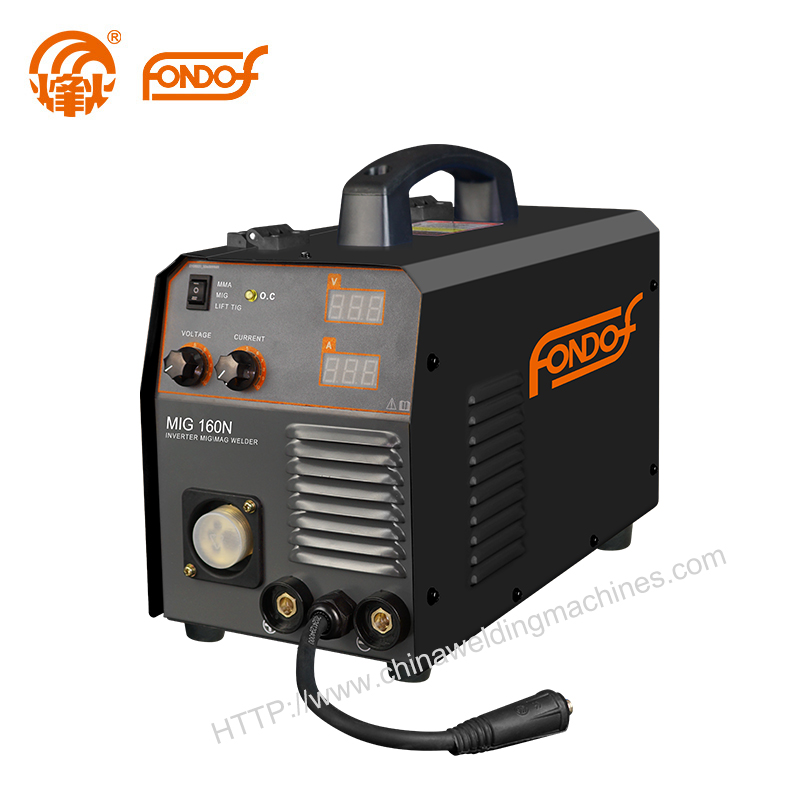
MIG/MAG Welding for Robotic Automotive Production Lines
Automation has become one of the most important developments in automotive welding.
Robotic MIG/MAG welding cells are widely used when manufacturers require consistent weld quality across thousands of identical components.
A typical automated welding system may include:
MIG/MAG welding power source
Industrial welding robot
Wire feeder
Welding torch
Positioner
Fixture system
Fume extraction equipment
Welding parameter control system
Modern welding power sources can communicate directly with robotic controllers, allowing welding parameters to change automatically between different joints.
This is particularly useful when a component contains different material thicknesses or welding positions.
Important MIG/MAG Welding Parameters for Automotive Parts
Automotive weld quality depends heavily on process parameter control.
Important parameters include:
Welding Current
Welding current affects penetration and deposition rate.
Excessive current can increase heat input and distortion, while insufficient current may produce poor fusion.
Arc Voltage
Voltage influences arc length and weld bead profile.
Correct voltage helps maintain a stable arc and consistent weld appearance.
Wire Feed Speed
Wire feed speed directly influences welding current and metal deposition.
Stable wire feeding is particularly important in robotic automotive production.
Welding Speed
Travel speed affects penetration, bead width, and heat input.
Automated welding systems allow travel speed to remain highly consistent across production batches.
Shielding Gas
Shielding gas selection affects:
Arc stability
Penetration
Spatter
Weld appearance
Metal transfer mode
The correct gas mixture should be selected according to the base material and welding requirements.
MIG/MAG Welding Machine Selection for Automotive Manufacturing
Automotive manufacturers should select welding equipment according to their materials, component thicknesses, production volume, and automation requirements.
Key factors include:
Required welding current range
Carbon steel or aluminum welding capability
Pulse MIG capability
Wire feeding stability
Duty cycle
Digital welding parameter control
Robot communication interfaces
Welding program storage
Arc stability
Spatter control
For high-volume production, equipment reliability is particularly important because welding machine downtime can interrupt an entire automotive assembly line.
Future Development of MIG/MAG Welding in the Automotive Industry
Automotive welding is moving toward greater automation, digitalization, and process control.
Major trends include:
Robotic welding integration
Digital welding power sources
Pulse MIG welding
Low-spatter welding processes
Welding parameter monitoring
Automatic fault detection
EV aluminum structure welding
Intelligent production data collection
As automotive manufacturers increasingly use lightweight materials and automated production lines, MIG/MAG welding technology will continue to evolve toward greater precision and repeatability.
Conclusion
MIG/MAG welding machines play an important role throughout automotive assembly and component manufacturing.
They are widely used for chassis structures, body reinforcements, seat frames, exhaust systems, brackets, aluminum components, commercial vehicle frames, and EV battery structures.
Their combination of high welding speed, continuous wire feeding, material flexibility, and compatibility with robotic automation makes MIG/MAG welding particularly suitable for modern automotive manufacturing.
For automotive manufacturers and Tier 1 or Tier 2 suppliers, selecting the correct MIG/MAG welding machine should be based not only on maximum welding current, but also on material type, component thickness, production cycle, automation requirements, and long-term process stability.
A properly configured MIG/MAG welding system can help improve weld consistency, reduce rework, increase production efficiency, and support reliable automotive component manufacturing.